
Weddings
How to Choose an Engagement Ring That Feels Right for the Person Wearing It
Choosing an engagement ring is one of the most personal purchases most people will ever make. Yet the process often starts in the wrong place. Many buyers begin with questions about budgets, carat weights, and certification grades before they have asked the more important question: what does the person who will wear this ring every…

Start With Observation, Not Research
The most useful information about what someone wants in an engagement ring rarely comes from a direct conversation. Most people have not sat down and formed a considered opinion on diamond shapes or setting styles. But they have noticed things. A friend’s ring that made them stop and look. A piece of jewellery they reach for every morning without thinking. A style they consistently admire without knowing why.
Pay attention to the jewellery someone already wears. If every piece is delicate and understated, a large solitaire on a thick band is probably not the right choice regardless of what is technically impressive at a given budget. If they wear statement pieces and gravitate toward bold design, a modest ring might feel like a disappointment even if the stone is technically excellent.
The people closest to the person you are buying for often hold the most useful information. A best friend or sibling who has had the conversation about weddings and rings is worth a quiet conversation before you begin shopping.
Understanding Ring Styles Without Getting Lost in Terminology
Once you have a sense of the aesthetic direction, the terminology becomes easier to navigate.
A solitaire setting holds a single centre stone and nothing else. It is the most classic engagement ring style and the most versatile because the setting draws no attention away from the stone. Almost any diamond shape works in a solitaire and the design tends to feel timeless rather than trend-dependent.
A halo setting surrounds the centre stone with a border of smaller diamonds. This makes the centre stone appear larger and adds visual sparkle. It suits buyers who want maximum presence at a given budget, though the style is more directly tied to current trends than a solitaire.
A pavé or channel set band adds small diamonds along the band itself, adding detail and light to the ring beyond the centre stone. This style works particularly well for people who like a finished, layered look and often wear multiple rings together.
A bezel setting encircles the stone in a rim of metal rather than holding it with prongs. It protects the stone more completely than a claw setting and suits people with active lifestyles who work with their hands. The silhouette tends toward the modern and clean rather than the traditional.
The Question of Diamond Shape
Shape is often the first decision and one of the most personal. The round brilliant diamond has been the most consistently popular engagement ring stone for decades, primarily because its proportions are optimised for light return and brilliance. A well-cut round brilliant in a simple setting is very difficult to get wrong.
Oval diamonds have grown significantly in popularity because they offer a similar brilliance to round stones while appearing larger face-up for the same carat weight. Their elongated shape also flatters most hand shapes.
Cushion cuts have a softer, more vintage feel with rounded corners and a deeper, glowing light pattern compared to the bright sparkle of a round brilliant. They suit buyers drawn to antique and romantic aesthetics.
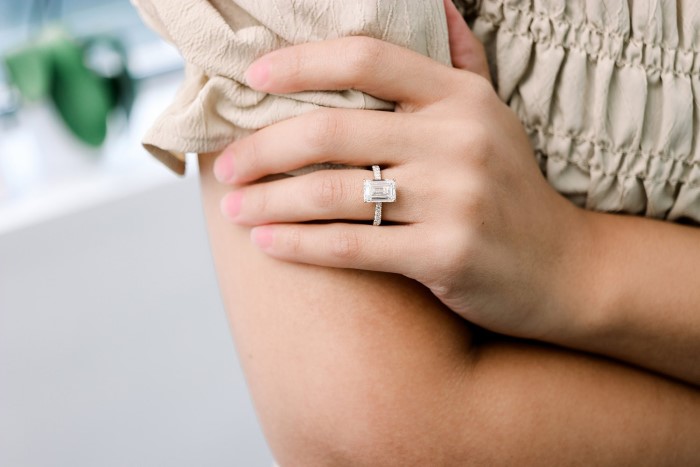
Emerald and Asscher cuts are step cuts rather than brilliant cuts, which means they show long, mirror-like flashes of light rather than the scattered sparkle of a brilliant. They are elegant and architectural and tend to suit people with a preference for refined, understated design. They also show inclusions more readily which means clarity matters more for these shapes.
Pear and marquise shapes are elongated and pointed, which creates a distinctive silhouette and a strong lengthening effect on the finger. They require confident personal style to carry well.
What Hatton Garden Offers That Standard Retail Cannot
For buyers who want a genuinely personal result, working with a specialist jeweller who builds rings from the ground up rather than fitting stones into existing settings makes a meaningful difference to the outcome.
London’s Hatton Garden jewellery quarter has been the centre of the UK diamond trade for over a century. The concentration of craftspeople, stone merchants, and independent jewellers in a single district creates an environment where bespoke work is genuinely possible at competitive prices. A buyer working with a Hatton Garden jeweller can specify the exact combination of stone, setting, metal, and proportions they want rather than choosing from existing stock.
The process typically starts with a consultation, moves through stone selection from a wide sourced inventory, and results in a piece manufactured to order. At Regal – Hatton Garden Jewellers, for example, access to over 2.5 million diamonds sourced worldwide means the process of finding a stone that genuinely matches the brief is not limited by what a single retailer happens to hold in stock.
Metal Choice and What It Means for Everyday Wear
Platinum is the most durable metal for engagement rings. It is denser than gold, holds settings more securely over time, and develops a soft satin patina rather than scratching through the way yellow gold can. It requires no plating or surface treatment to maintain its colour. The trade-off is cost, as platinum is considerably more expensive than gold.
White gold is less expensive than platinum and achieves a similar appearance through rhodium plating. Over time the plating wears and the ring will need re-plating every few years to maintain its colour. This is a minor cost and the process is straightforward, but it is worth knowing in advance.
Yellow gold has no maintenance requirements of this kind and its warm tone is currently experiencing a genuine revival in engagement jewellery. It also has the useful property of making any slight warmth in a diamond’s colour grade appear whiter by contrast, which can allow a buyer to choose a lower colour grade without any visible difference in the finished ring.
Rose gold has a distinctive warmth that flatters most skin tones and pairs particularly well with cushion and oval shaped diamonds. Like yellow gold it requires no rhodium plating to maintain its appearance.
The Fitting Question
Ring size is a practical matter that many buyers leave too late. An incorrect size is fixable but resizing adds time and cost and some settings cannot be resized without affecting the design. Most established jewellers will advise on discreet ways to establish the correct size without revealing the purchase, including comparing with a ring the person already owns or asking a trusted friend or family member who may already know.
A Final Note on Timing
Custom and bespoke rings take longer to produce than selecting from existing stock. If there is a specific date in mind, building in adequate lead time for the manufacturing process removes pressure from the decision and allows the right stone to be found rather than the fastest available option.
The best engagement ring is the one that feels inevitable the moment the person wearing it sees it. Getting there is a process of listening, observation, and working with the right people.

How to Choose an Engagement Ring That Feels Right for the Person Wearing It

Destination Wedding Photographer Guide: Stunning Tips

Wedding Catering Cost Guide: Smart Savings & Tips

Wedding Table Decorations: Stunning Ideas That Wow
